
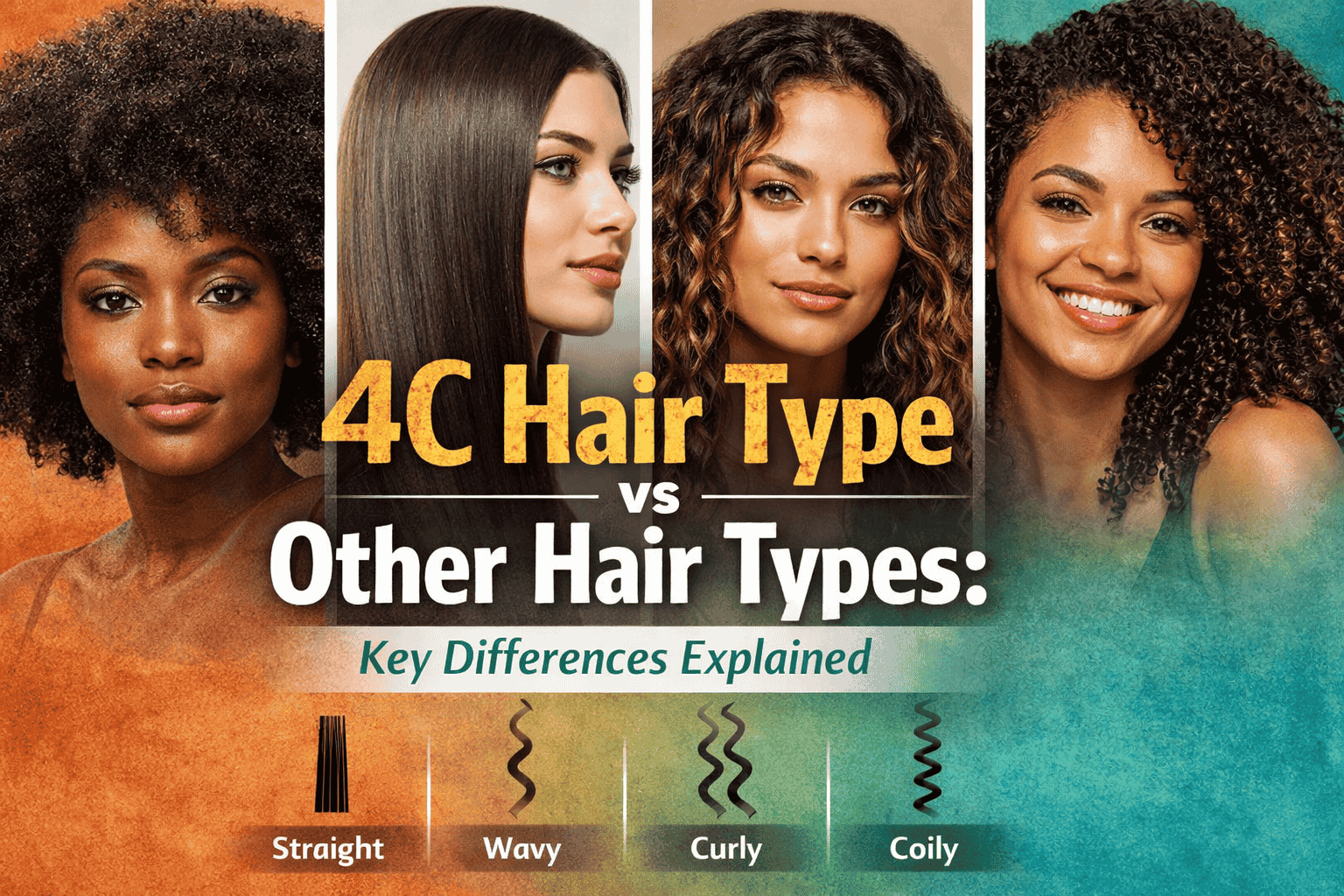
Understanding your hair type is the foundation of proper hair care. Among all hair textures, 4C hair stands out as one of the most unique and misunderstood. It belongs to the Type 4 (coily/kinky) category and is often compared with other hair types, such as straight (Type 1), wavy (Type 2), and curly (Type 3), as well as other coily textures like 4A and 4B. In this guide, we’ll break down the key differences between 4C hair and other hair types to help you better care for your strands.
What is 4C Hair?
4C hair is characterized by extremely tight, densely packed curls or coils that often have no clearly defined curl pattern. It typically shrinks up to 70–80% of its actual length, making it appear much shorter than it really is. This hair type is fragile and prone to dryness because natural scalp oils struggle to travel down the tight coils.
Key characteristics of 4C hair:
- Tight zig-zag or undefined curl pattern
- High shrinkage
- Naturally voluminous
- Prone to dryness and breakage
- Requires consistent moisture and gentle handling
Overview of Other Hair Types
Before diving into comparisons, here’s a quick look at other hair types:
- Type 1 (Straight): No curl pattern; naturally smooth and often shiny
- Type 2 (Wavy): Loose S-shaped waves; moderate texture
- Type 3 (Curly): Defined curls ranging from loose to tight ringlets
- Type 4A & 4B (Coily): Tighter curls than Type 3, but more defined than 4C
Key Differences Between 4C Hair and Other Hair Types
1. Curl Pattern and Definition
One of the biggest differences lies in the curl structure.
- 4C hair: Has very tight coils with little to no visible definition
- Type 3 hair: Features clearly defined ringlets
- Type 2 hair: Displays loose waves
- Type 1 hair: Completely straight
4C hair’s curl pattern can sometimes appear “undefined,” but it actually forms very tight zig-zag bends rather than spirals.
2. Shrinkage
Shrinkage refers to how much hair shortens when dry.
- 4C hair: Experiences the most shrinkage (up to 80%)
- 4A/4B hair: Moderate shrinkage
- Type 3 hair: Some shrinkage
- Type 1 & 2 hair: Minimal to none
Shrinkage in 4C hair is a sign of elasticity and health, even though it can make length retention feel frustrating.
3. Moisture Retention
Moisture is crucial for all hair types, but the way each type retains it differs.
- 4C hair: Struggles to retain moisture due to tight coils blocking oil distribution
- Curly and wavy hair: Moderate moisture retention
- Straight hair: Natural oils easily travel down the shaft, making it less prone to dryness
Because of this, 4C hair often requires heavier creams, oils, and leave-in conditioners.
4. Fragility and Breakage
4C hair is the most delicate among all hair types.
- 4C hair: Highly prone to breakage due to tight bends and dryness
- Curly hair (Type 3): Moderately fragile
- Wavy and straight hair: Generally stronger and less prone to breakage
The structure of 4C hair creates multiple weak points along each strand, making gentle handling essential.
5. Volume and Density
4C hair naturally appears fuller than other types.
- 4C hair: High volume, dense appearance
- Curly hair: Moderate volume
- Straight hair: Lies flat, less voluminous
This natural fullness is one of the most celebrated features of 4C hair.
6. Styling Versatility
4C hair offers unmatched styling versatility, though it may require more effort.
- 4C hair: Can be shaped into afros, twists, braids, and protective styles
- Curly hair: Easier wash-and-go styles
- Straight hair: Easier heat styling and sleek looks
However, 4C hair often needs more preparation, such as detangling and moisturizing before styling.
7. Maintenance Routine
Each hair type requires a different care approach.
4C hair routine:
- Deep conditioning regularly
- Protective styling
- Low manipulation
- Moisturizing frequently
Other hair types:
- Less intensive routines
- More frequent washing
- Minimal heavy products
4C hair thrives on consistency and patience.
4C Hair vs 4A and 4B Hair
Even within Type 4, there are noticeable differences:
- 4A hair: Has small, defined S-shaped coils
- 4B hair: Features a Z-shaped pattern with less definition
- 4C hair: The tightest coils with minimal visible pattern
4C hair is often the most compact and requires the most moisture among the three.
Common Myths About 4C Hair
Many misconceptions surround 4C hair:
Myth 1: 4C hair doesn’t grow
Truth: It grows at the same rate as other hair types but may appear shorter due to shrinkage.
Myth 2: It’s unmanageable
Truth: With the right routine, 4C hair is highly versatile and beautiful.
Myth 3: It’s always dry
Truth: It requires more moisture, but proper care can keep it hydrated.
How to Care for 4C Hair Effectively
To maintain healthy 4C hair, focus on these essentials:
- Hydration: Use water-based products regularly
- Sealing moisture: Apply oils or butters
- Gentle detangling: Use wide-tooth combs or fingers
- Protective styles: Braids, twists, or buns reduce breakage
- Night care: Satin or silk scarves/pillowcases
Final Thoughts
4C hair is unique, beautiful, and full of character. While it requires more attention compared to other hair types, its versatility and volume make it incredibly rewarding to care for. Understanding how it differs from straight, wavy, and curly hair allows you to embrace its natural texture and build a routine that keeps it healthy and thriving.
Whether you have 4C hair or are simply learning about different textures, appreciating these differences helps promote better hair care practices and greater confidence in natural beauty.
FAQs (Frequently Asked Questions)
1. What makes 4C hair different from other hair types?
4C hair has the tightest coil pattern with little to no visible curl definition, high shrinkage, and a greater need for moisture compared to other hair types.
2. Does 4C hair grow slower than other hair types?
No, 4C hair grows at the same rate as other hair types. However, shrinkage can make it appear shorter, and breakage can affect length retention.
3. How often should 4C hair be moisturized?
4C hair should be moisturized regularly, ideally every 2–3 days, depending on your routine and climate, to prevent dryness and breakage.
4. Is 4C hair harder to manage than other hair types?
Not necessarily. It requires a different approach, focusing on moisture, gentle handling, and protective styles, but it is very manageable with the right care.
5. What are the best hairstyles for 4C hair?
Protective styles like twists, braids, bantu knots, and afros work well for 4C hair, helping to retain moisture and reduce breakage.