
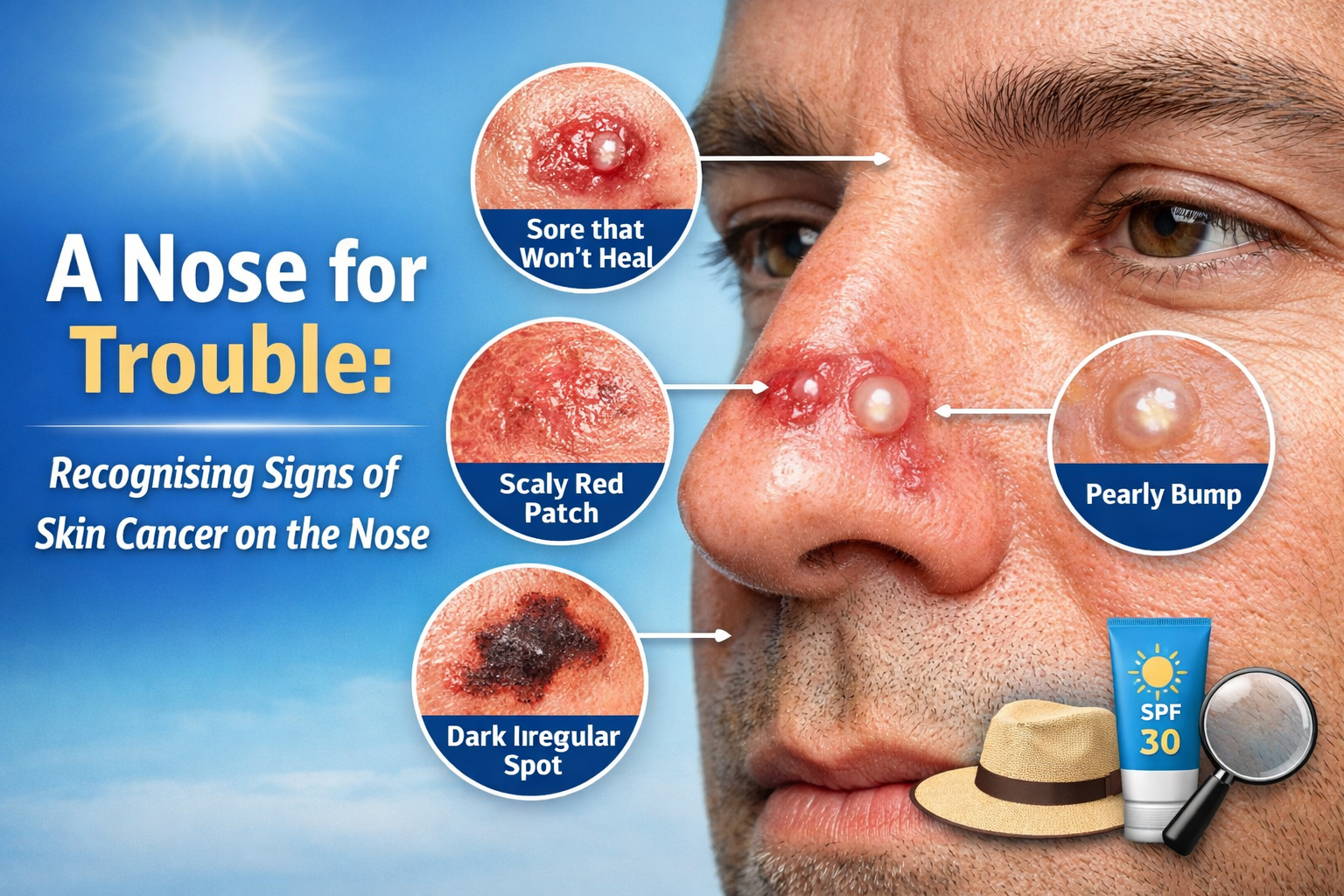
The nose sits at the center of the face and takes the brunt of daily sun exposure. Whether you’re walking outdoors, driving, or enjoying a holiday, your nose is often the most sun-exposed part of your body. Unfortunately, this constant exposure makes it one of the most common sites for skin cancer, particularly in sunny climates.
Skin cancer on the nose can be subtle at first, appearing as a small scab, a red patch, or a non-healing sore. Many people dismiss these early signs as harmless pimples or sun damage. However, ignoring these warning signs can allow cancer to grow deeper, making treatment more complex and potentially disfiguring.
This guide will help you understand how to recognise early signs of skin cancer on the nose, the types involved, risk factors, diagnosis, and prevention, so you can act early and protect both your health and appearance.
Why the Nose Is a High-Risk Area for Skin Cancer
The nose protrudes from the face, catching direct sunlight throughout the year. Unlike other body parts, it’s rarely fully covered by clothing, and sunscreen is often applied unevenly or forgotten altogether.
Key reasons the nose is vulnerable include:
- Constant UV exposure
- Thinner skin structure
- High concentration of oil glands
- Frequent sunburns over a lifetime
Over time, ultraviolet (UV) radiation damages skin cells, leading to mutations that can trigger the development of cancer. Even people who rarely burn but tan easily are still at risk.
Types of Skin Cancer Commonly Found on the Nose
Skin cancer on the nose usually falls into three main categories:
Basal Cell Carcinoma (BCC)
- Most common type
- Grows slowly
- Rarely spreads but can cause significant tissue damage
- Often appears as a pearly bump or non-healing sore
Squamous Cell Carcinoma (SCC)
- More aggressive than BCC
- Can spread if untreated
- Often appears as a scaly patch or ulcer
Melanoma
- Less common but highly dangerous
- Can spread rapidly
- Often appears as a dark, irregular spot
Early detection dramatically improves treatment outcomes for all three types.
10 Key Signs of Skin Cancer on the Nose You Should Never Ignore
1. A Sore That Doesn’t Heal
If a sore on your nose bleeds, scabs over, and reopens repeatedly for more than four weeks, it’s a major red flag. Normal wounds heal; skin cancer doesn’t.
2. Pearly or Shiny Bumps
Basal cell carcinoma often looks like a small, shiny, skin-colored or pink bump. It may resemble a pimple, but it won’t go away.
3. Persistent Red or Pink Patches
Flat, rough, or itchy patches that linger could indicate early squamous cell carcinoma, especially if they slowly enlarge. Persistent itching without a visible rash can sometimes signal deeper issues. Certain cancers are known to cause ongoing skin itchiness.
4. Crusting, Bleeding, or Oozing Areas
Unexplained bleeding or crust formation without injury is a warning sign. Cancerous lesions often have fragile blood vessels.
5. A Lump That Feels Firm or Tender
A hard lump under the skin, particularly if it’s painful or growing, should be examined by a dermatologist.
6. Scaly or Rough Skin That Won’t Smooth Out
Persistent roughness that doesn’t improve with moisturiser may indicate actinic keratosis, a precancerous condition.
7. Dark Spots or Uneven Pigmentation
Melanoma on the nose may appear brown, black, blue, or even colorless, with irregular borders and uneven shading.
8. Changes in an Existing Mole
Any mole on the nose that changes in size, shape, color, or sensation (itching, bleeding) needs immediate attention.
9. Sunburn Sensitivity That Persists
If a spot on your nose remains sore or inflamed long after sun exposure, it could indicate damaged or abnormal cells.
10. A Scar-Like Area Without Injury
Some skin cancers resemble flat, pale scars that slowly spread. These are easy to overlook but potentially dangerous.
Who Is Most at Risk?
You may have a higher risk of skin cancer on the nose if you:
- Have fair skin, light eyes, or freckles
- Have a history of sunburns
- Spend long hours outdoors
- Use tanning beds
- Are over 50 years old
- Have a family history of skin cancer
- Live in high-UV regions
That said, anyone can develop skin cancer, regardless of skin tone or age.
How Skin Cancer on the Nose Is Diagnosed
A dermatologist will:
- Visually examine the lesion
- Use dermoscopy for magnified inspection
- Perform a skin biopsy if cancer is suspected
Biopsies are quick and usually done under local anesthesia. Early diagnosis often means simpler treatment and minimal scarring.
Treatment Options for Skin Cancer on the Nose
Treatment depends on cancer type, size, and depth:
- Mohs Surgery – Gold standard for facial skin cancers; preserves healthy tissue
- Standard Surgical Excision
- Cryotherapy (freezing)
- Topical chemotherapy creams
- Radiation therapy (for non-surgical cases)
Early treatment typically results in excellent cosmetic and medical outcomes.
Prevention: Protecting Your Nose from Skin Cancer
Simple daily habits can dramatically reduce your risk:
- Apply broad-spectrum SPF 30+ sunscreen daily
- Reapply sunscreen every 2 hours outdoors
- Wear wide-brimmed hats
- Avoid peak sun hours (10 am–4 pm)
- Perform monthly skin self-checks
- Get annual dermatology screenings
Your nose deserves extra attention—it’s often the first place skin cancer appears.
Why Early Detection Matters
When detected early, skin cancer on the nose is:
- Highly treatable
- Less invasive to remove
- Less likely to leave scars
- Rarely life-threatening
Delaying diagnosis can lead to deeper invasion, complex reconstruction, and increased health risks.
Also Read: https://y3koutfits.com/what-is-the-best-cream-for-skin-cancer/
Final Thoughts
Your nose may seem like an unlikely place for cancer, but it’s actually one of the most common. Paying attention to subtle skin changes can make all the difference. If something on your nose looks unusual, lasts longer than a few weeks, or keeps changing, trust your instincts and get it checked.
Early action saves skin, appearance, and lives.
Frequently Asked Questions (FAQs)
1. Is Skin Cancer On The Nose Common?
Yes, the nose is one of the most common sites due to constant sun exposure.
2. Can Skin Cancer On The Nose Be Painless?
Absolutely. Many skin cancers cause no pain, which is why they’re often overlooked.
3. How Fast Does Skin Cancer Grow On The Nose?
Growth varies—basal cell carcinoma grows slowly, while melanoma can progress rapidly.
4. Will Removing Skin Cancer Leave A Scar?
Modern treatments, such as Mohs surgery, minimize scarring, especially when detected early.
5. Should I See A Doctor For A Small Scab On My Nose?
Yes, if it doesn’t heal within 3–4 weeks or keeps returning.